THE RISE OF AI-GENERATED DESIGN
THE RISE OF AI-GENERATED DESIGN
And Why Intentional Design Still Matters
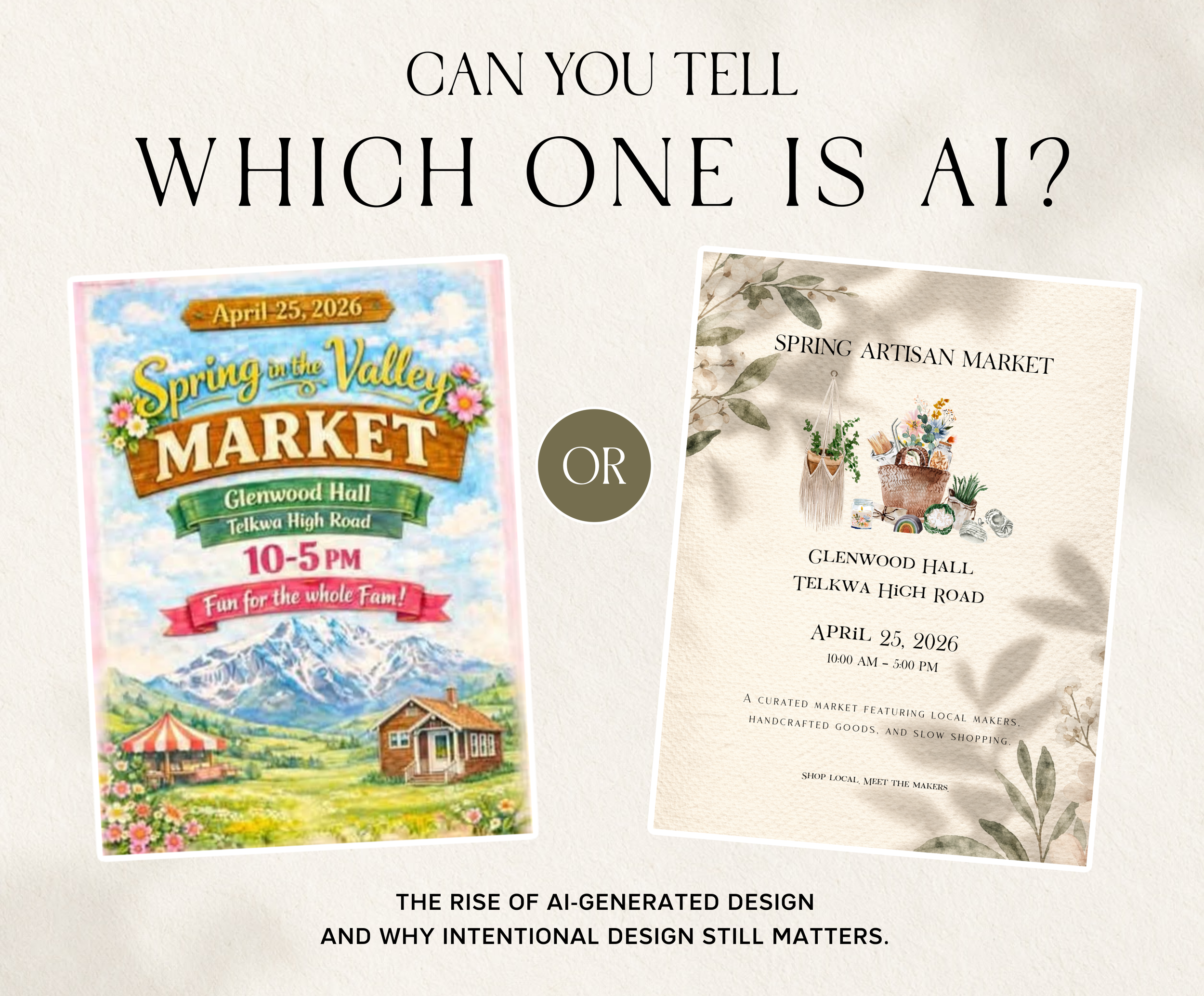
Can you tell which one was designed?
It's an interesting question.
Not because one was created with artificial intelligence and the other wasn't, but because most people instinctively know which one feels more intentional.
Over the past year, social media has become flooded with AI-generated event posters, advertisements, logos, menus, and promotional graphics. If you've spent any time scrolling lately, you've probably noticed the trend. They all seem to share the same visual language: dramatic lighting, decorative typography, oversaturated colours, and every available inch filled with something designed to demand attention.
Ironically, the more AI-generated designs I see, the more they begin to look exactly alike.
Recently I've even noticed something else happening. Designers, tattoo artists, musicians, event organizers, and everyday consumers have started pushing back.
I've seen people openly saying they won't attend events promoted with AI-generated flyers. Others joke that we're living through an "AI flyer pandemic." While those posts are often tongue-in-cheek, they reveal something deeper.
People are craving authenticity again. Not perfection. Not expensive branding. Just something that feels intentional.
Whether you agree with those sentiments or not, I think they point toward something much more interesting.
People aren't rejecting technology.
They're responding to a lack of intention.
And those aren't the same thing.
The Conversation Isn't Really About AI
Before anyone sharpens their pitchforks... No, I don't think AI is the enemy. I understand using it to brainstorm ideas. Organize thoughts. Write rough copy. Explore concepts.
But here's the important distinction.
Please don't mistake the first draft for the finished product.
Think of AI as one tool in a toolbox. It isn't a creative director.
For many, AI has become an incredibly valuable creative assistant. And that's exactly what it is: an assistant. Not a replacement for creative direction, taste, or design.
There's an important distinction between using AI as a tool and asking it to do your creative thinking for you.
Design is a series of decisions.
Take the two posters above.
One immediately grabs your attention with bright colours, decorative banners, multiple typefaces, mountains, flowers, a cabin, a carnival tent, and layer upon layer of visual effects competing for your attention.
The other is considerably quieter.
They're connected in a way you might not expect. The poster on the right wasn't created in a vacuum. It was a redesign after one of the event vendors sent me the AI-generated version on the left and asked if I could create something that felt more intentional.
That experience isn't unique. In fact, it's happened several times this year.
Good design isn't about adding more.
It's about knowing what to leave out.
It's understanding hierarchy, proportion, rhythm, balance, contrast, and restraint. It's deciding what your audience should notice first, second, and third.
Those decisions aren't made by software.
They're made by people.
But faster isn't always better.
I completely understand why so many small businesses are embracing AI. Running a business is expensive. Hiring a designer isn't always realistic, especially when you're just starting out. Sometimes you simply need to get something posted quickly.
I genuinely understand that.
But branding has always been about more than simply filling a blank page.
Every flyer, menu, advertisement, website, or social media post communicates something about your business before anyone reads a single word. When your marketing feels rushed or generic, that becomes part of your brand, whether you intended it or not.
First impressions have always mattered.
AI hasn't changed that.
Here's What Fascinates Me Most
The easier it becomes to generate average-looking graphics, the more valuable thoughtful design becomes.
At first, many people assumed AI would replace designers.
In many ways, I think the opposite is happening.
When everyone has access to the same prompts, the same aesthetics, and the same shortcuts, creativity is no longer about who has the technology.
It's about who has the judgment to use it well.
That's why I don't think AI has made designers less valuable.
I think it's made good designers more valuable.
Because when anyone can create something, the people who know how to create the right thing become even more important.
That's something no prompt can replicate.
Taste.
Restraint.
Experience.
Storytelling.
Those qualities have always separated good designers from everyone else, and if anything, I believe they're becoming even more valuable.
The artisan market wasn't an isolated project.
It's become a pattern.
This year alone, I've been contacted several times by businesses asking me to redesign AI-generated advertisements.
Not because the software failed.
It actually did exactly what they asked.
It produced a flyer.
What it didn't produce was their flyer.
It didn't understand who they were, who they were trying to reach, or how they wanted people to feel when they walked through the door.
Those are conversations.
Those are decisions.
That's design.
The Future Isn't AI or Designers
I don't believe we're choosing between artificial intelligence and human creativity.
The future belongs to people who understand how to use both.
AI is not going away any time soon.
But AI doesn't replace creativity.
AI is remarkably good at accelerating ideas.
Humans are remarkably good at deciding which ideas deserve to exist.
That's a partnership, not a competition.
Technology will continue to evolve, just as it always has. Designers have adapted through desktop publishing, digital photography, Canva, smartphones, and countless other innovations.
AI is simply the next chapter.
But no matter how advanced the tools become, one thing remains true.
People don't connect with software.
They connect with intention.
They remember thoughtful experiences.
They notice craftsmanship.
They trust brands that feel authentic.
The businesses that stand out won't necessarily be the ones using the newest tools.
They'll be the ones using those tools with intention.
Technology changes.
Good design principles don't.
Typography still matters.
Hierarchy still matters.
Brand identity still matters.
Storytelling still matters.
Human creativity still matters.
Because at the end of the day...
As AI makes it easier than ever to create something, it also makes it easier than ever to recognize when someone truly designed it.
Perhaps that's the greatest irony of all.
AI can generate a graphic.
Only people can tell a story worth remembering.